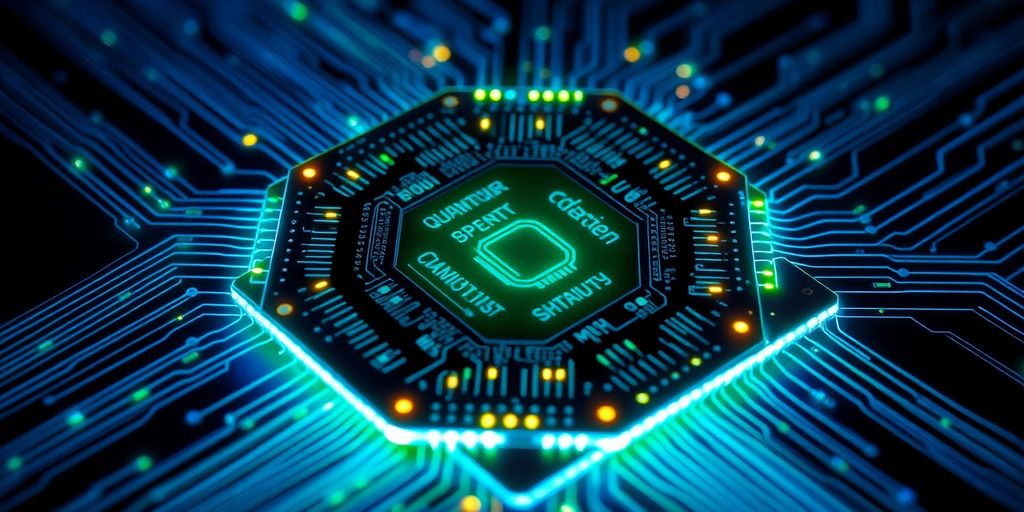
Google has made a groundbreaking announcement with the unveiling of its new quantum computing chip, Willow. This state-of-the-art chip boasts 105 qubits and can perform complex calculations in just five minutes—tasks that would take classical computers an unfathomable 10 septillion years. This leap in technology is set to revolutionize various fields, including medicine, artificial intelligence, and energy solutions.
Key Takeaways
-
Willow can solve problems in five minutes that would take classical supercomputers 10 septillion years.
-
The chip demonstrates significant advancements in quantum error correction, reducing errors as qubit numbers increase.
-
Google aims to make quantum computing practical for real-world applications, enhancing industries like pharmaceuticals and AI.
The Significance Of Willow
Google's Willow chip represents a monumental step in quantum computing, addressing long-standing challenges in the field. Traditional computers struggle with tasks that require immense computational power, particularly in areas like drug discovery and climate modeling. Willow's ability to perform calculations at unprecedented speeds positions it as a game-changer in the tech landscape.
Breakthroughs In Quantum Error Correction
One of the most notable achievements of the Willow chip is its enhanced quantum error correction capabilities. Historically, as more qubits are added to a quantum system, error rates tend to increase, undermining the advantages of quantum computing. However, Willow has demonstrated that it can reduce errors exponentially as qubit numbers grow, a feat that has eluded researchers for nearly three decades.
-
Error Reduction: Willow achieved an exponential decrease in error rates while scaling from a 3x3 grid to a 7x7 grid of qubits.
-
Real-Time Error Correction: The chip can correct errors in real-time, making it a practical solution for complex computations.
Implications For Various Industries
The implications of Willow's capabilities extend far beyond theoretical advancements. As quantum computing becomes more commercially viable, industries that rely on heavy computational tasks are poised for transformation.
-
Pharmaceuticals: Rapid calculations can significantly speed up drug development processes.
-
Artificial Intelligence: Enhanced computational power allows for more complex data analysis and machine learning algorithms.
-
Energy Solutions: Quantum computing can optimize battery designs and improve energy efficiency in various applications.
The Future Of Quantum Computing
Google's commitment to advancing quantum technology is evident in its establishment of a dedicated fabrication facility for the Willow chip. This move is expected to accelerate the development of future quantum systems, allowing for faster iterations and innovations.
As the race for quantum supremacy heats up, Google is not alone. Other tech giants like IBM and Microsoft are also investing heavily in quantum research, but Google's focus on qubit quality over quantity may give it a competitive edge.
Conclusion
The unveiling of the Willow chip marks a pivotal moment in the evolution of quantum computing. With its ability to perform calculations at speeds previously thought impossible, Willow is set to redefine the boundaries of technology and open new avenues for solving complex global challenges. As Google continues to refine its quantum systems, the potential for practical applications in various industries becomes increasingly tangible.