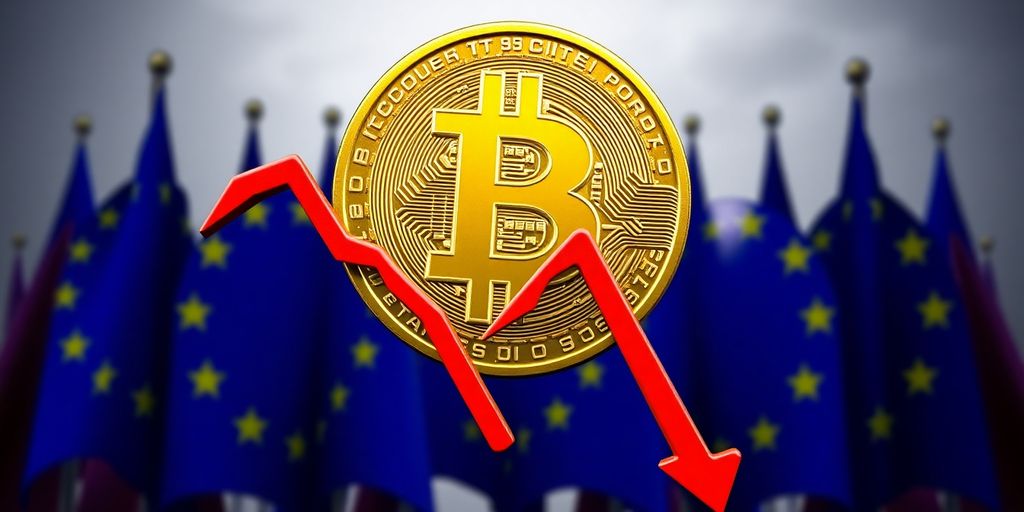
The European Union's recent announcement of retaliatory tariffs against the United States has raised concerns among cryptocurrency analysts, who warn that Bitcoin's price could drop to as low as $75,000. This development comes in response to U.S. tariffs on steel and aluminum, intensifying trade tensions and creating uncertainty in the markets.
Key Takeaways
-
EU to impose counter-tariffs on $28 billion worth of U.S. goods starting April.
-
Analysts predict Bitcoin may revisit the $75,000 support level due to market volatility.
-
Broader economic conditions and institutional adoption also influence Bitcoin's price.
Background on Tariff Developments
On March 12, the European Commission announced that it would impose counter-tariffs on U.S. goods valued at approximately 26 billion euros ($28 billion). This decision is a direct response to President Donald Trump's recent implementation of a 25% tariff on steel and aluminum imports. The EU's tariffs are set to take effect on April 13, following the expiration of a current suspension on tariffs against U.S. products.
Market Reactions and Predictions
Analysts are closely monitoring the potential impact of these tariffs on Bitcoin's price. Marcin Kazmierczak, co-founder of RedStone, noted that the introduction of counter-tariffs signals a potential escalation in trade tensions, which could lead Bitcoin to test the $75,000 support level. He stated, "Counter tariffs aren’t a positive signal as they suggest a potential bounce back from the other side again."
Other analysts, including Ryan Lee from Bitget Research, suggest that while tariffs are a significant factor, they are not the sole influence on Bitcoin's price. Lee emphasized that Bitcoin's value is also affected by broader economic conditions, regulatory updates, and increasing institutional adoption, which may provide resilience against traditional market fluctuations.
Short-Term Volatility Expected
The uncertainty surrounding global trade tariffs is likely to create volatility in both traditional and cryptocurrency markets until at least April 2. Aurelie Barthere, a principal research analyst at Nansen, indicated that the ongoing tariff discussions could suppress market risk appetite during this period. She stated, "Tariff noise is likely to continue till after April 2, and the reciprocal tariff announcements, and then negotiations, will put a lid on risk appetite."
Conclusion
As the EU prepares to implement its retaliatory tariffs, the cryptocurrency market braces for potential volatility. Analysts remain cautious, predicting that Bitcoin could see a correction to $75,000 amidst the backdrop of escalating trade tensions. However, the overall resilience of Bitcoin, bolstered by institutional interest and regulatory developments, may mitigate some of the adverse effects of these tariffs. Investors are advised to stay informed and monitor market conditions closely as the situation evolves.