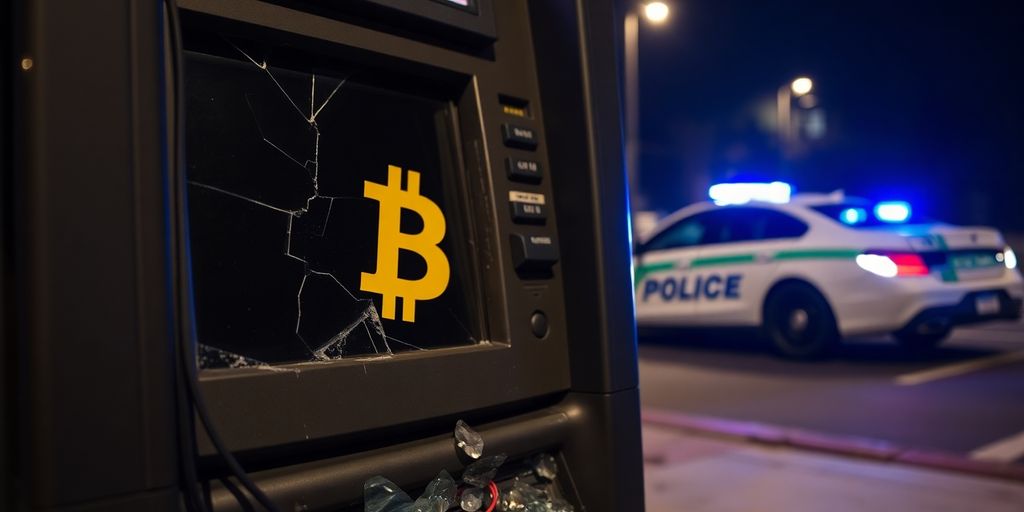
Bitcoin Depot, a major Bitcoin ATM provider, alleges that some law enforcement officials are illegally damaging their machines and seizing funds. The company's legal chief claims these "rogue" officers are overstepping their authority, causing significant financial losses for the company, and creating new victims in their attempts to recover funds for scam victims.
Bitcoin ATM Seizures: A Growing Concern
Bitcoin Depot's Chief Legal Officer, Chris Ryan, has voiced strong concerns regarding law enforcement's methods of seizing funds from their Bitcoin ATMs. Ryan states that police occasionally use brute force, including power tools, to access cash within the machines. This practice not only destroys the expensive equipment but also seizes funds that, according to Bitcoin Depot, rightfully belong to the company.
The Cost of "Rogue" Actions
-
Property Damage: A recent incident in Texas involved authorities using power tools to retrieve $32,000 from a Bitcoin Depot kiosk, rendering the $14,000 machine a total loss. Bitcoin Depot COO Scott Buchanan noted that such actions often "total" the machines.
-
Financial Liability: While Bitcoin Depot is willing to unlock machines for legitimate seizures, they expect law enforcement to cover damages. However, municipalities often lack the resources for restitution, leaving Bitcoin Depot to absorb the losses.
-
Legal Disputes: The company has successfully defended similar unlawful actions by law enforcement in multiple states, including North Carolina, Virginia, Massachusetts, Louisiana, and Washington.
Understanding the Business Model and Scams
Scammers frequently exploit the irreversible nature of crypto transactions and Bitcoin ATMs to defraud individuals, often by impersonating government agencies or banks. An FBI report indicated that Americans lost at least $247 million through crypto kiosks in 2024, a 31% increase from 2023.
Bitcoin Depot clarifies its business model:
-
A customer inserts cash into the ATM.
-
Bitcoin Depot sells the corresponding amount of Bitcoin directly to the user.
-
The user provides a wallet address to receive the Bitcoin.
Ryan emphasizes that once the transaction is complete and the Bitcoin is sent to the chosen wallet, Bitcoin Depot's involvement ends. The company feels for scam victims but asserts its right to the cash in the machines, as the actual theft occurs when scammers trick users into sending Bitcoin to their wallets.
Legal Precedent and Company Efforts
Despite law enforcement's attempts to portray seized cash as crime proceeds, courts are beginning to side with Bitcoin Depot. The Iowa Supreme Court, in two separate cases this year, ruled that Bitcoin Depot was entitled to the victims' cash. This is based on the company's terms of service, which require users to confirm ownership of the receiving digital wallet and warn against providing third-party addresses.
Bitcoin Depot actively collaborates with law enforcement to combat scams:
-
They partner with crypto analytics firms like Elliptic to offer transaction tracing tools.
-
A dedicated team, including former law enforcement personnel, works with local authorities to explain their business model and assist victims in filing complaints with the FBI's Internet Crimes Complaint Center (IC3).
While "smash and grab" incidents are not the majority, Ryan notes that a general lack of understanding about how crypto works often contributes to these situations. Bitcoin Depot continues its efforts to educate law enforcement and assist in legitimate investigations.
Sources
-
'Rogue' Police Are Destroying Bitcoin ATMs: Bitcoin Depot Legal Chief, Decrypt.
This article was created with support from AI-driven technology, drawing on multiple reputable sources. The final content has been thoroughly reviewed and edited by BlockzHub's editorial team to ensure accuracy, clarity, and coherence. Original reporting sources are credited whenever appropriate and as required. The opinions expressed in this article do not necessarily represent the official views or positions of BlockzHub. This article is intended for informational purposes only and should not be considered financial or professional advice. Investing involves risk, and you should consult a qualified financial advisor before making any investment decisions.