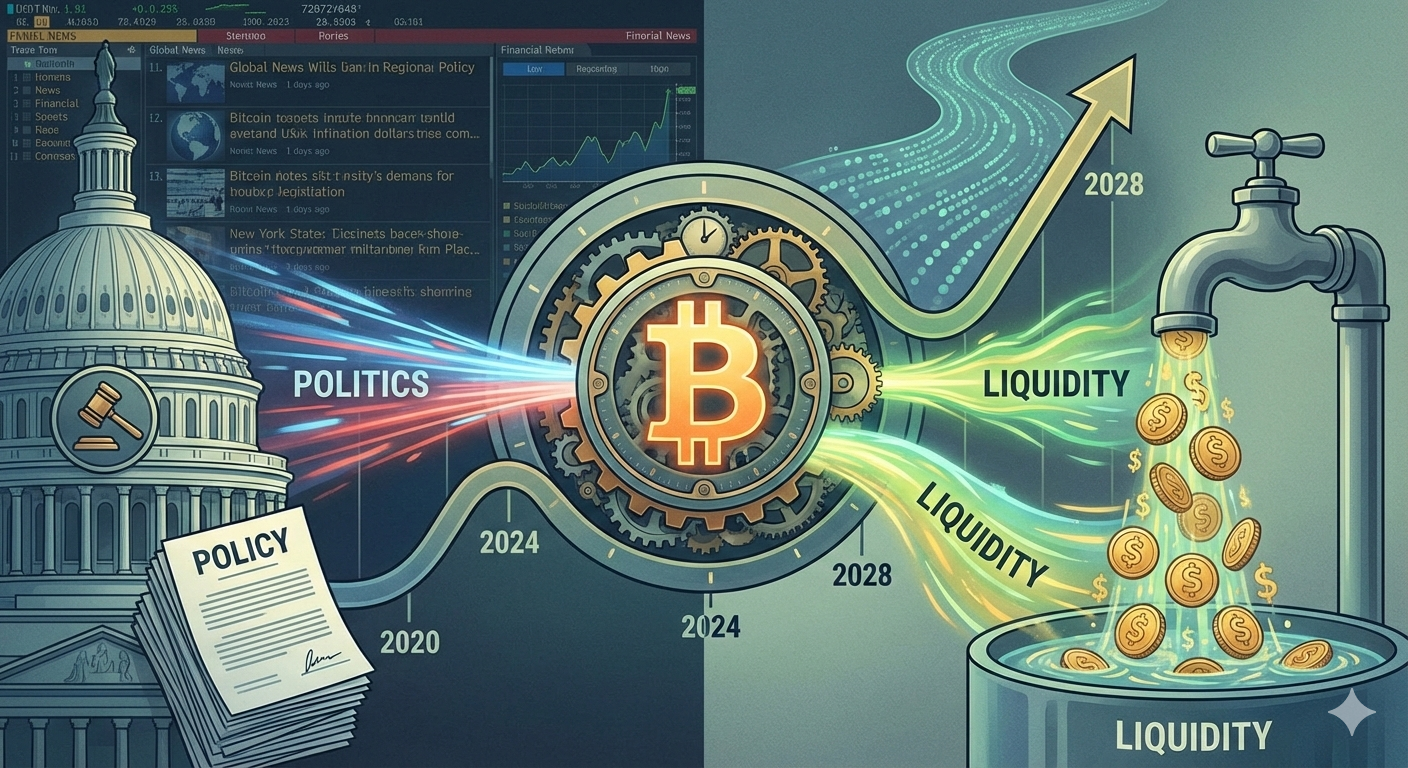
The long-observed four-year cycle in Bitcoin, historically tied to its halving events, is facing intense scrutiny. While some analysts believe the cycle is intact, others argue that new market dynamics, particularly institutional involvement and global liquidity shifts, are fundamentally altering Bitcoin's price behavior. This debate raises questions about the future predictability of the cryptocurrency's market movements.
Key Takeaways
-
The traditional four-year Bitcoin cycle, driven by halving events, may be losing its predictive power.
-
Institutional adoption and sustained ETF inflows are introducing counter-cyclical dynamics.
-
Global liquidity, macroeconomic factors, and market sentiment are increasingly influencing Bitcoin's price.
-
While some indicators suggest the cycle is breaking down, others point to its continued, albeit modified, relevance.
The Traditional Cycle Under Pressure
For years, Bitcoin's price action has followed a predictable pattern: a surge following the halving event, peaking the subsequent year, and then entering a prolonged "crypto winter." This cycle was largely driven by retail investors and the programmed scarcity introduced by halvings. However, recent market behavior has deviated from this historical script. Despite the 2024 halving, the expected speculative "blow-off top" in 2025 has not materialized as anticipated, leading some to declare the four-year cycle "dead."
New Drivers: Institutions and Liquidity
A significant shift in the Bitcoin market is the increasing influence of institutional buyers. The advent of Bitcoin ETFs and growing corporate adoption have introduced consistent capital flows that operate independently of the halving cycle. Analysts like Tom Lee suggest that these sustained inflows are creating counter-cyclical dynamics, potentially decoupling Bitcoin from its traditional four-year trajectory. Furthermore, global liquidity conditions have shown a strong correlation with Bitcoin's price, suggesting that monetary policy and the availability of capital are becoming more dominant factors than the halving's supply shock.
Economic Activity and Sentiment's Role
While some investors look to economic indicators like the US Purchasing Managers' Index (PMI) for clues, their correlation with Bitcoin's price is proving unstable. Bitcoin can act as a "risk-on" asset during economic expansion or a "risk-off" hedge during uncertainty, making its relationship with real economic activity complex. Sentiment, however, remains a powerful, albeit volatile, driver. In the absence of traditional valuation metrics like earnings, investor belief and market psychology, amplified by social media and 24/7 trading, can lead to extreme price movements, especially during euphoric bull runs or sharp downturns.
The Evolving Landscape
Despite the challenges to the traditional four-year cycle, some analysts maintain that its fundamental principles remain relevant. While the halving might not be the sole driver, its impact on mining economics and long-term scarcity narratives persists. Recent data suggests that Bitcoin's cycle maturity, in terms of price action and holder behavior, still bears resemblance to historical patterns. The consensus appears to be that Bitcoin is maturing as an asset class, with its price now influenced by a complex interplay of macroeconomic factors, institutional demand, global liquidity, and persistent market sentiment, rather than a single, predictable four-year rhythm.
Sources
-
Bitcoin’s Famous 4-Year Cycle Is Breaking Down — What Now? — TradingView News, TradingView.
-
Institutional Buyers May Break Bitcoin’s Traditional Four-Year Cycle, Tom Lee Warns, Yahoo Finance.
This article was created with support from AI-driven technology, drawing on multiple reputable sources. The final content has been thoroughly reviewed and edited by BlockzHub's editorial team to ensure accuracy, clarity, and coherence. Original reporting sources are credited whenever appropriate and as required. The opinions expressed in this article do not necessarily represent the official views or positions of BlockzHub. This article is intended for informational purposes only and should not be considered financial or professional advice. Investing involves risk, and you should consult a qualified financial advisor before making any investment decisions.